We left Alaska after five weeks of exploration. Our last stop in the 49th state was Chicken, Alaska, along the Top of the World Highway. We drove over four hours in pristine wilderness to reach the ferry to get into Dawson City. Admittedly the ferry had us both up a tree of sorts, wondering if Louie would be able to get on and off without incurring any damage. We were snugged up tight on that deck, but we were able to cross. In Dawson City, we ripped it up a bit, enjoying the almost 24 hours of sunlight and the frontier town atmosphere. We took part in the tradition of the Sour Toe Cocktail, and we enjoyed two of the can-can shows at Diamond Gertie’s. After Dawson City we plowed down to Whitehorse, the big city around these parts. There, we re-provisioned Louie. Border crossings back and forth meant we needed to carefully manage the allowable foods. We’ve gotten really good at eating down the supplies, crossing over to the new country, and then re-stocking the larder.
Through the Yukon and British Columbia we did A LOT of driving. It’s a long way from the US to the US. The scenery was wild, dense, and beautiful. The roads were in good enough condition, and there were enough services along the way to keep the gas tank full. We listened to the audio version of the novel “The Hail Mary Project.” That carried us pretty far, honestly. And we caught sight of wildlife mostly through this section of the drive. Bear, caribou, elk, fox. The weather wasn’t great. Showers, clouds, windy, gray. Good enough driving weather, and perfectly fine when not pitching a tent. Outside of Whitehorse, we did our first true dispersed camping as all the campgrounds were full by the time we rolled in. We found a flat spot at a boat launch parking lot off the highway and managed to get a good night’s sleep.
The next morning broke gray and rainy. We got back on the road for six more hours of the same. It stayed gray until after we arrived at Boya Lake. We took full advantage of clearing skies by renting a canoe (via the honor system) and exploring the lake. The waters were that unbelievable glacial blue. We paddled, grateful for the fresh air and to not be driving. We had a magical encounter with a couple loons and a very large, playful river otter. We had still had a long way to travel, so it was early to bed and early to rise. At least the weather was clearing as we pushed on to our next stop at Meziadin Junction, BC. Larry took advantage of the weather and did a lot of cooking outdoors, overlooking the lake. Things got rainy and gray again as we rolled towards Burns Lake, but free camping can brighten any day. Actually, Burns Lake was a wonderful example of quality community space. There was a small lot for dry camping, free. There was an excellent community center with drop in rates to work out and shower. We could have skated or rock-climbed too, if we were so inclined. There was a lovely, large playground and splash pad along the lake. They had a skate park, a grassy field, a gazebo, public bathrooms, a kayak self-rental station, some body weight exercise stations, a dock, waterslide, and comfortable places to sit and just enjoy. A short drive away was a free RV dump station and potable water fill station. It felt like such a welcoming place to land. We appreciated their hospitality.
Six hours after leaving Burns we rolled into Alberta and right into the town (and National Park) of Jasper. The weather was still quite variable. Very windy, occasional rain showers, cloudy. Overnight the storm raged and blew fiercely enough to rock the van. By morning, things had quieted down and the sun was shining again. We ended up with gorgeous weather for Jasper, Banff, and Waterton Lakes. To be able to experience those pearls with warm, sunny weather was exceptional. Many of the workers — a distant, shellshocked look in their eyes — would tell us that it’s been raining for weeks, and that we were lucky to have the sun. We believe it.
Jasper: Jasper experienced a catastrophic fire in 2024. Over a third of the town was destroyed and over 80,000 acres of forest was consumed. I wasn’t sure how heartbreaking it would be but it felt important to come and support the community as it rebuilds. Even though it’s been two years, there is still an overwhelming presence of the fire. Trailers still house residents and workers. Construction is a constant in the town. acres of trees are gone, reduced to blackened husks of stalk and stump. But! There are echoes of the tragedy everywhere, but there is also an undeniable resilience and renewal. The grasses are filling in the fields. The wildflowers are blooming with a vengeance. The animal and insects are doing their things. Life is continuing. Hope is ever-present. And it’s all so beautiful. After a couple days, your eyes don’t see the dead and burned, they see the green and growth.
Unlike most of the US National Parks, these Canadian Rockies parks are inclusive of the towns surrounding the sites and trails. Once you enter the town, you enter the park. We camped in the Wapiti campground. It was badly burned in the fire. It’s barren, but it’s mostly open again for campers. The community center in the heart of the town was impressive. Meeting spaces, community fridges, childcare, fitness, aquatics, showers, and so much more in the campus. We were grateful to go there twice and use their facilities. One of our days in Jasper, we rented e-mountain bikes and rode up and down and all around. All told, we rode about 20 miles over the great trails. We went though fields that were once forest, and around the miraculous aspen and douglas fir both of which are fire resistant. The next day we hiked around the Five Lakes, and continued to marvel at the new beauty amid the scars. The next day it was time to move on to Banff. The ride from Jasper to Banff is famously gorgeous. The Icefields Parkway is loaded with impressive natural wonders. Waterfalls, glaciers, ice fields, lakes, rivers, wildlife, mountains. It could be a full day’s worth just to see the sights along the way. The weather had once again turned rainy and cloudy, so we were not inclined to stop too much. We did go to the Alabasca Falls, and hiked out among the moraine of the glacier on our way into Banff National Park. We also stopped at the very amount Peyto Lake. Infamously crowded, we might have passed it over, but we were late enough in the day that we could easily get parking. I am so glad we took the time to see it because it was absolutely beautiful. It is one of those quintiessential glacier blue lakes, viewed from on high. It was a wonderful appetizer for what the next couple days would hold.
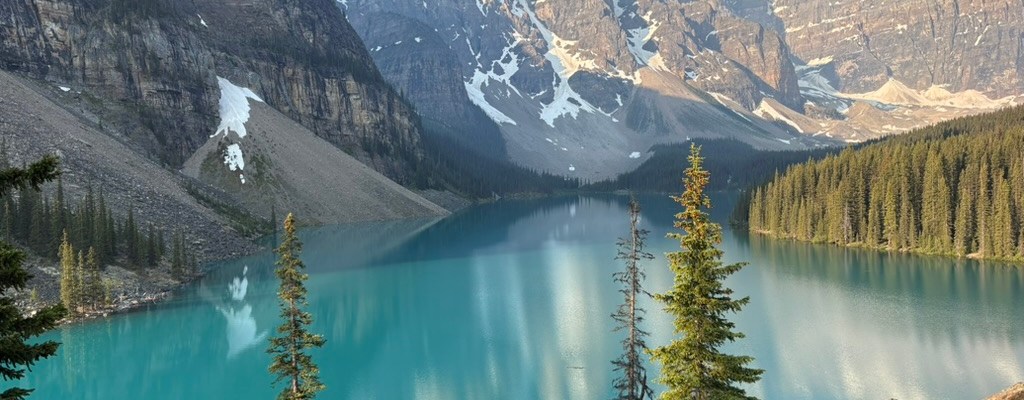
Banff: We had reservations at Lake Louise Campground, which was not on or terribly near Lake Louise, the lake. It was, however smack in the middle of Lake Louise, the town. It was also relatively close to the pick up area for our shuttle busses, so we were able to make our 6:30 am bus to Lake Moraine. This is the reason many people come to Banff National Park, and rightly so. We lucked out with weather and the time of day was perfect. We weren’t with the sunrise crush, but neither were we with the 10 tour bus crush. We walked up to the overlook called The Rock Pile. From there we enjoyed our thermoses of coffee while overlooking a scene straight out of a fairy tale. The color of the water is magical. The old growth forest is dense and fragrant. The mountains are massive and breathtaking. After our coffee we headed down to the lake and rented a canoe for an hour and a half of pure bliss. We were among the first to the rental so we had the lake pretty much to ourselves. We paddled all around the edges, admiring the small details. We took countless photos and none of them do the scene full justice. It’s simply incredible. After our allotted time, we caught our shuttle over to Lake Louise, the lake. Because it was midday with gorgeous weather the crowds were thick. We hiked up to an overlook, leaving most of the people behind. There we enjoyed taking it all in. This lake is also very pretty, but in my opinion it comes in third after Moraine and Peyto. What it did have that the others did not was civilized amenities. So we had a lovely al fresco lunch looking out at the glory and partaking in people watching.
the next day we drove to the town of Banff, about 45 minutes away from Lake Louise. We drove the Bow Valley Parkway, and lovely scenic byway that meanders through the forest along the Bow River. We found an excellent fitness and aquatics center, so we took full advantage of that. Then we wandered the town, enjoyed a lovely urban hike along the river to the falls, and then watched the US lose their world cup match at Sheepdog Brewing.
The next morning, we checked out of the campground, repeated the Bow Valley Parkway and the fitness and aquatics before making our way to the town of Canmore en route to our last Canadian Rockies National Park. Canmore was adorable! It was also surrounded in glorious mountains and rivers (a pretty common theme here). It had a lovely, walkable downtown. We grabbed lunch and then enjoyed their wetland boardwalk and their excellent ice cream. We lingered quite a while, but eventually we needed to get going as we still had a few hours of driving before nightfall. Luckily it gets dark pretty late as the scenery was really beautiful. We spent a lot of time watching the forests turn to prairies turn to farmland. Alberta really is quite stunning to drive through.
Waterton Lakes: We came into Waterton Lakes and were immediately smitten with the little village there on the lake. Another charming alpine village, this one smaller than the others. The Prince of Wales Hotel perches up on the bluff overlooking the lake and the village. Waterton Lakes is the sister park to Glacier National Park in the US. They both sit on their respective sides of the international border. And while Glacier gets large crowds, Waterton felt smaller and more family friendly. The campground was full of families, with kids running everywhere playing and laughing. We decided to appreciate Waterton Lakes by exploring the village and having a relaxing day of eating in the town and wandering the lakeside paths. We walked up to the Prince of Wales Hotel, following a well worn narrow path through a hilly meadow, overgrown with shrubs and trees. We enjoyed a cocktail in the historic lounge. Afterwards we were outside taking in the views with several other people. We were about to head back down the trail when a woman on the balcony shouted down that two bears were on the path rapidly approaching the hotel. That was unexpected and a little startling. We kept a safe distance as the mama and baby cub came up to the edge of the hotel property and then skittered down the other side of the hill. Once she was out of sight well in the opposite direction did we noisily make our way back down the hill. We rounded out the evening by watching some of the live events from the Calgary Stampede on the TV while listening to a really good guitarist at the Thirsty Bear. The next morning we left via the scenic bison loop, that was rather lacking in bison, but was a very pretty place to have lunch. And then less than an hour later, we were back in the USA.
We feel we know Canada a little better after this adventure. We’ve spent a lot of time driving its roads, taking in its scenery, appreciating its wilderness and wildlife. While we still have more of the country to experience, we loved our time in Alberta, British Columbia, and the Yukon. We are especially grateful to have been welcomed so warmly to three of their national parks.
Drive times:
Whitehorse YT 6 hr
Boya Lake BC 5.5 hr
Meziadin Junction BC 6 hr
Burns Lake BC 4.5
Jasper NP, AB 6
Banff NP, AB 3.5
Waterton Lakes NP, AB 4.

