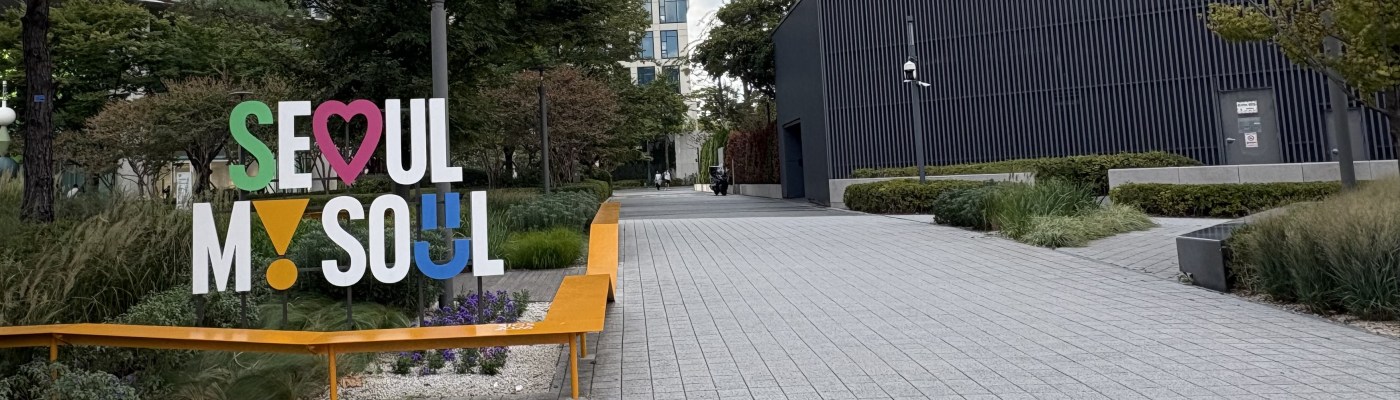
We’ve just spent a month in Seoul, South Korea. It was such an incredible experience. My senses were bombarded on a daily basis (so much to see, taste, smell, hear, and touch), but as the days turned into weeks I was able to take in more, look above the ground level, understand more of the language. One month is hardly enough time to get to know a place, but it is enough for a start. Our time in Seoul confirmed a lot about ourselves. Larry and I now absolutely feel that embedding in a place for a period of time is our favorite way to travel. Obviously it’s not always possible, but when it is, the results are rewarding. Because this is not our first time at a month-long stay, we have a bit of a routine.
We spent the bulk of the first week getting settled in (laundry, grocery, transportation, gym, etc). We know that establishing a daily physical routine is critical for our mental and physical health. During a time when neither of us is working at a full time job, having a workout routine grounds us and gives our day some structure. We chose a gym that was a 30 minute walk from the house, ensuring we got some steps in before we even got there. And in that first week, the walks to and from the gym helped us get familiar with our temporary home. We got our chores and requirements out of the way that first week and even had time for legitimate touristy stuff, like palaces and cooking classes and poking about some of the other interesting neighborhoods. But we spent the bulk of that first week really exploring our immediate surroundings. Seongsu-dong is a very real neighborhood in greater Seoul. It’s an area that was primarily industrial, but has been slowly evolving into a residential, artistic, and culinary destination. Comparatively it is gritty (but completely safe), often lacking sidewalks (ok, sometimes less safe in this category). There may not have been a pretty view out of any of the 6 windows of our rented flat, but we could hear little kids giggling and singing on their way to school in the mornings, and old ladies gossiping in the afternoon, and old men hucking and spitting at all hours.
Week two saw us exploring further afield and digging into some of the touristy must do’s while in Seoul: Palaces, parks, rivers, streams, temples, neighborhoods, festivals, and light shows. Seoul is VAST. It is over 600 square kilometers and has over 9.5 million residents. It is smaller, denser, and more populated than NYC. It also has one of the best subway and rail systems in the world. But even with that we walked miles and miles and miles, which was good because we also very much enjoyed the food and drink there. Restaurants, markets, and bakeries gave us a chance to practice with our baby tourist Korean words and phrases. For certain I can say that Koreans are very serious about food. From street vendors to high end steak houses and everything in-between, there has been craft and quality, and pride in serving the best they can. I can say with confidence that we like places with interesting culinary scenes. We are shamelessly food motivated. Without getting too graphic, while we loved eating the food, our biomes never really settled in Korea, which was an uncomfortable side effect we learned to live with and plan around.
Digestion issues aside, we like being outside our comfort zones. We like being surrounded by people and languages different from ourselves. It’s hard. It’s challenging. It can be uncomfortable and often lead to small humiliations, but it also can lead to incredible connections and insights into humanity and community and culture. We felt very welcomed (or at least tolerated or benignly ignored). I spent some time picking my way through Hangul, the Korean alphabet, and trying to learn some basic phrases and words. And whenever a neighbor smiled or nodded at me and exchanged a greeting it totally made my day.
During week three we flung ourselves completely outside of Seoul to several new areas of the country. We took a day long bus tour and visited the DMZ to look upon North Korea with our own eyes. Later in the week we took a high-speed train down south Gyeongju and then southeast to walk the sandy beaches and climb the hilly, colorful neighborhoods of Busan. We made sure the days that were spent in Seoul included still more new neighborhoods and tourist sights. We walked A LOT. So many stairs. So many miles of walking.
For the first three weeks we had mostly gorgeous weather. But as our final week rolled in the weather took a turn. It became gray and rainy and windy and then the temperatures really dropped, close to freezing for one day, and then just cold and windy for another blip. The local clothing shops all put out the puffers and fleece. The leaves all took the hint and started changing colors quickly. The ginkgo trees turned gold and the maples turned electric red. We left before it was peak, and while it wasn’t quite New England foliage, it was definitely beautiful.
For that last week, we bundled up and continued exploring new adjacent neighborhoods as well as revisiting of the city wall over in the Jongo neighborhood. We also visited the National Museum of Korea, which was truly excellent and educational. Larry was particularly taken with the Pensive Buddhas in the Quiet Contemplation Room. My favorite part was learning about the Mogao Caves, first dug in 366, and expanded over the years to a complex cave temple structure that they believed held 16 different caves. But in 1900 they discovered a 17th cave, known as the Library Cave, which had been completely walled in behind a false mural wall. This cave contained over 60,000 cultural artifacts including scrolls that had been hidden away and protected for over a 1000 years. Because they were sealed in so tightly they remained in excellent condition. It was all so fascinating. I couldn’t help but think of all the ancient civilizations around the globe. We’ve been fortunate to see similar museums in Egypt, Athens, Rome, and Pompeii. This was my first exposure to Asian ancient culture. The traces of humanity that we are able to piece together, and the similarities in technologies and cultures always impresses me and leaves me contemplative.
Historic pondering aside, the last week also saw us having three excellent meals, of what they would call “western cuisine,” which I think covers everything that isn’t explicitly Asian. To be honest, by week four we were ready to take a break from gochujang and kimchi. We had a delicious dish of eggplant, onion, mushroom, and bacon over rice that I am still dreaming of and urging Larry to recreate. We then had a fancy-pants dinner that was equal parts excellent cuisine and entertaining fire theatrics. And our last meal in Seoul was an excellent vegetarian dinner, which was part of the highlight of the trip, more for the company than the food.
We got to spend a precious few hours with our future daughter-in-law, Alexa, and their dearest friend, Nova. This was not a preplanned gathering, but rather a happy coincidence we discovered early. Over the summer we had a funny moment when the conversation turned to future plans. “We’re going to Asia in the fall.” “Wait! We are too!” We quickly discovered that not only were we going to the same city (Seoul) but that we were essentially going to be departing the day the kids arrived. In less than a heartbeat we changed our plans by a day so that we could at least see them briefly before moving on. So on the 30th, we four threaded the needle beautifully and met for that excellent vegetarian dinner (not terribly common there) and a little Halloween people watching in Itaewon. It was a perfect end to our time in Seoul.
Some final thoughts, impressions, and observations
South Korea is an amazing country. I would return if I ever got the chance. I could see doing an expat assignment there for a few years too. The general culture is one of consideration of others and community and collective. There are thoughtful touches everywhere. It is a conservative culture in general. People dress modestly, well, and mostly in the bruised palette. Outside of the tourist areas, my bare arms were often the only ones seen, despite the warm temperatures. They are pretty strict on trash and recycling. My impression was that in the deeper neighborhoods, like our section of Seongsu, there was more garbage, trash, and liter about. But I think that it is a residual of not yet being gentrified. In general, Seoul was very clean and well tended. The people in general appear mostly healthy and active at all ages. They are proponents of physical activity and have outdoor exercise equipment areas in every neighborhood. Despite the healthy appearance there is noticeable smoking and vaping. What’s interesting is that people do not walk and smoke. They tuck into side alleys. People do not walk and eat there either. But boy howdy do they walk with their iced coffees. Everyone everywhere it seemed walked around with an iced coffee. Stores and restaurants even have specific shelves for people to put their drinks down and they collect them again when they leave. The open air markets are a cultural treasure as well as a critical community resource. The people on whole are kind and welcoming to tourists. Technology helped us bridge the gaps in language. They prioritize natural green spaces, whether it’s along the river or in the heart of the city. Everywhere there are flowers, gardens, trees. The babies were so stinking cute, the children were all so well behaved, and the dogs were spoiled and pampered. We seriously saw more dogs in strollers than children. And as I mentioned earlier, the food game was so strong. Bakeries there rivaled any I’ve tasted anywhere. It is a very safe honest culture. There is little risk of your possessions being stolen. People actually use their wallets or phones as a way to hold their space at a table while they walk away to order or collect food. The youth (teens and twenties) are mostly swept up in the K-pop K-drama and selfie culture. There’s an entire model of business that offers photo environments with props and lighting. They queue up for it. They also queue up for pop ups, which also seem to be the rage there, whether clothing or art, or a fad food. I know that as foreigners and outsiders, we are not privy to depths of the culture, nor are we held to the same standards. I know these observations are skewed. That being said, I loved it there. As the author Min Jin Lee said: There is so much wrong with the Korean culture, but there is so much right. I am deeply appreciated of those parts that they’ve gotten right.

