We flew from JFK to Singapore, a 16 hour flight (great tail winds). We left on September 22 and arrived on the 24th. It’s as close to time travel as one can get. The flight was great. Singapore Airlines knows a thing or two about comfort. We both managed to get a good amount of sleep on the flight over, and as a result, when we landed at 4:00 in the morning we both felt reasonably well rested and ready for adventure.
We grabbed our bags and hopped into a taxi. Happily, the hotel was willing to let us check in early (for a fee, of course). That was wonderful. It allowed Larry to catch a catnap and I headed down to the gym and the pool for some much needed movement. We freshened up and headed into Chinatown where we met our food tour guide. That’s right: in a move that sounded crazy, we booked a full day food tour for the day we landed. It was in fact a stroke of genius. It gave structure to our day, forced us to be out in the fresh air and sunshine, determined what we would be eating, and gave us an excellent base on which to build our few, precious days in this city state.
The tour was small. Just our guide, Gerry, and two women from New Zealand on their last day in the country. We started in a hawker center in Chinatown, where Gerry got the party started by bringing over numerous dishes and several large bottles of beer. He was personable, not just with us but with the locals. He introduced them all to us, from Stewart who has been making satay for 30 years, to the hunched, ancient “auntie” who clears the tables. When we raised an eyebrow at the volume of food, just at this first stop, he explained that he wanted us to be able to have a wide exposure to all the different foods. But he also assured us that it will not go to waste. He packs the leftovers and brings them over to the elderly locals who frequent the halls.
The food in these hawker centers is culturally important. Fresh, homemade, family run and owned for generations. Several of them are also award winners. Indeed we saw several Michelin star recipients. Below is the list of what we ate that morning at the Chinatown Complex Market and Food Centre:
• Fresh coconut water (in the shell) and fresh sugar cane water
• Popiah (Fresh Spring Rolls)
• Fried Popiah (Deep Fried Spring Rolls)
• Kueh Pie Tee
• Chicken Curry Puffs
• Satay (Pork / Chicken / Lamb) with Ketupat (Rice Cakes)
• Hainanese Chicken Rice
• Soup Dumplings (Xiao Long Bao)
• Fried Pork & Chives Dumplings (Guo Tie)
• Red Chilli Oil Dumplings
• Steamed Rice Cakes with Sweetened Radish Toppings
• Durian and jackfruit
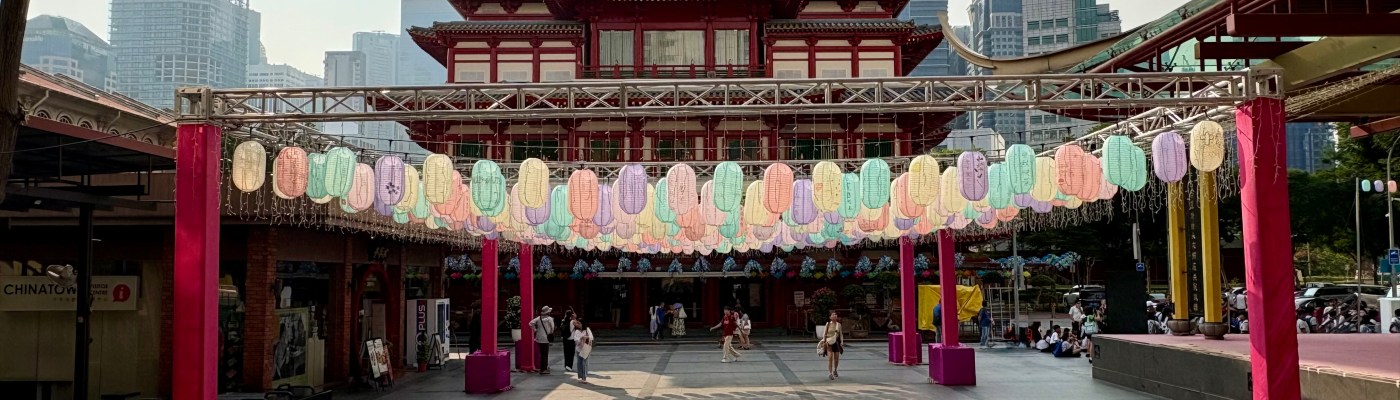
While we ate, and between exchanges with the locals, Gerry talked about the history of Chinatown, of Singapore, and of the region as a whole. He talked about the society, the integration, the appreciation of immigrant labor. The conversation was flowing and comfortable. He fielded all our questions and asked many of his own. Once we were all stuffed (and we were stuffed), we cleaned our table (we’d be charged a fine if we didn’t), and made our way to the Buddha Tooth Relic temple next door. There we covered our bits that needed covering, and walked through the immense and ornate temple. There was a service happening, so we were able to respectfully walk through as the monks chanted and prayed. Gerry explained some of the intricate symbols on display, what the different offerings meant, and helped us find our particular Buddha based on our birth year in the Chinese cycle. Gorgeous inside and out (even with two sides of the facade being under renovation), this temple had the added benefits of being free, having clean (non-squat) toilets, and having air conditioning.
We left the temple and made our way to Little India. Colorful, vibrant, and dense, this neighborhood has several stalls along the street, and malls filled with clothing shops, fabric stores, and tailors hard at work making clothing by hand. Sparkly, bright, patterned, intricate, modest, and traditional, the clothes for formal occasions were as stunning as they were varied. We also wandered the indoor food market stalls where we saw giant seafood, countless fruits and vegetables, all imported as Singapore does not produce the majority of its food. After wandering the stalls we ended up in a large, family-run restaurant that specializes in North/South Indian / Indian Muslim / Malay cuisine. There we sampled the following dishes:
• Seeraga Chicken Briyani
• Pepper Lamb
• Onion Rawa Masala Dosai
• Kadai Chicken
• Roti Prata
• Channa Masala (Chick Peas)
• Fish Curry
• Chicken Curry
• Papadum (Fried Lentil Flour Crisps)
Again, while eating we learned more about Singapore, the lightly authoritarian, capitalist, parliamentary society that Prime Minister, Lee Kuan Yew, created out of the wake of separating from Malaysia. We marveled at some of the things that are banned (besides the normal things in most societies) e.g., any drug use, vaping and e-cigarettes, gum selling and chewing, littering, fighting, not flushing a public toilet, spitting in public, being nude at home if neighbors can see you, public drinking after 10:30 pm, feeding pigeons, jay walking, and unauthorized protests. Even at Speakers’ Corner, which is the only official free speech area in the country, you are still not allowed to talk about anything related to religion or racial conflicts. The Singaporians take integration very seriously, right down to mandating even racial distribution in public housing. In this diverse country there are are about 10 official religions and four official languages: Malay, Tamil, English, and Mandarin.
We also learned a few things that I don’t think necessarily fit with a food tour, per se, but certainly fit with a historic and cultural introduction to the city state. In Chinatown we learned about the opium trade and subsequent addiction plague that swept up one in four Chinese men in the early 1900s. Gerry even has license to use for educational purposes his own grandfather’s yanqiang (opium pipe). We were able to examine it outside the store that once housed one of the many opium dens in Chinatown. Given the societal damage that this colonial export caused to the local population, it is no wonder that present day Singapore has such strong anti drug laws. While in Little India Gerry told us about Thaipusam, the Tamil festival that has its Hindu followers piercing themselves in unbelievable ways. He showed several pictures to illustrate the point, and the squeamish among us had to look away. When we made our way to Kampong Glam, the Arabic Quarter, he also showed us several pictures and videos on caning, which quite frankly serves as a tremendous reinforcement to stay within the right side of the law while there. Caning is still used as judicial punishment for the more serious crimes (sexual offenses, violence, vandalism, drugs). If you are a male under 50 and you commit one of these crimes, you could be subject to up to 24 lashes/strokes with a 1.2 meter rattan cane on your bare ass. The videos in particular were horrifying. The excellent gelato we were enjoying did not sweeten the images.
After the piercings but before the caning, we did get to wander through Kamong Glam. This is the hip part of town. Lots of influencers and wannabes swarming all over Arab Street and Haji Lane. Cool shops, whacky pet cafes (pugs, cats), and curiously ridiculous photo booths with manufactured settings that seem all the rage with the youth. Overshadowing the quarter is the golden domed Sultan Mosque. Fun fact: the ridge under the gold dome is actually soy sauce bottles, like original earthship designs. In this neighborhood there are beautiful wall murals, ample choices for food and beverages, and so much to look at. And it was here, after our gelato, that our tour ended and we said goodbye to Gerry. By this time, it was 4:30 pm and we had done a fantastic job of staying awake and beating the jet lag.
The remainder of our time in Singapore was tamped down a bit by me having a low-grade virus. We definitely took it easy. But that didn’t stop us from seeing the Merlion, The Sands, The Gardens by the Bay, the Supertree Grove, the City Museum, the Formula 1 racetrack, an up close and personal magic show, or from visiting hawker centers every day we were there. We ate well, we drank well, and we made great use of the plethora of mall-like indoor shopping spaces to avoid the one day of intense rain and the other days of intense heat. We had some incredible hand-pulled noodles, delicious mango shaved ice, kaya toast and eggs (that I would kill to have again right this very minute), pork dumplings, fried oyster cakes. Really, we didn’t have a bad (or expensive) meal the entire time.
We will get one more pass through Singapore when we make our way home in December. At that time we will be able to explore the Jewel complex there with the crazy waterfalls and jaw-dropping architecture and green spaces. But for now, it’s on to Seoul, South Korea.

